
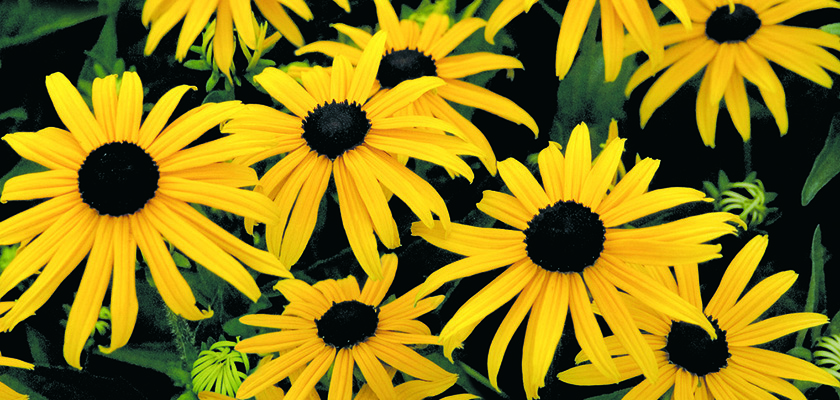

Goldsturm
Art.-Nr.: RF0101T- FastraX Perennial - first-year flowering without vernalization
- Premium, summer-flowering perennial
- Eye-catching, yellow flowers in landscape
- Use as border, pot or container plant
- Attracts bees and other pollinators


- Crop Time
- Frühjahr: 24 - 30 Wochen
- Höhe ∅
- 70 cm
- Standort
- Sun - Partial shade
- Seed Form
- ApeX
- Heat Zone
- 9-2
- Hardiness Zone
- 3a-9b
- Product Use
- Topfpflanze, Containers, Borders
Technical Guide
Optimal storage: Up to 6 months at 5 °C / 41 °F
Sow time
January-April for flowering from July onwards; May-August for flowering in the following year
Sowing method
3-4 seeds per plug
Germination
Cover the seeds with a thin layer of vermiculite. Germinate at 68-72 ºF (20-22 ºC) for the first 5-10 days. No vernalization is required.
Growing on
Grow on at 50-65 ºF (15-18 ºC). Start growing under short day conditions (< 12 hours) for the first 6-7 weeks to get well-branched plants. Then change to long days (>15 hours) as high light intensity will result in flower initiation and faster flowering. Proper moisture and temperature management reduce the use of growth regulators. Depending on the season of cultivation, regular light sprays of paclobutrazol and uniconazole can be applied.
Media
Use a well-drained, growing substrate, pH: 5.8-6.5. In the field, loamy sandy to sandy humus soils with good drainage and good nutrition levels are of advantage.
Temperature
Grow at 54-64 °F (12-18 °C) or outdoors. In winter, a frost free indoor cultivation at minimum 37-41 °F (3-5 °C) or an outdoor cultivation with a fleece cover are possible.
Fertilization
High fertilization levels are required. Fertilize the crop weekly with 150-225 ppm nitrogen, using a complete balanced fertilizer, or use every irrigation to feed with 100-150 ppm. Avoid high ammonium and high nitrogen levels. For an overwintering production, don’t fertilize after mid September. In spring fertilize 150-200 ppm nitrogen of a potassium balanced fertilizer. Prevent magnesium and iron deficiency.
Moisture Codes
| Saturated (5) | Water is easily observed when finger is pressed on cell. Water moves freely from the top of the plug to the bottom. |
| Wet (4) | Media looks black and is not glistening. The media feels wet to the touch but there is very little water movement. |
| Moist (3) | Water is not easily visible. When finger is pressed on the cell there is very little movement from top to bottom. |
| Medium (2) | Media is not black, but now looks medium brown. There is no water movement when pressed with finger. |
| Dry (1) | Media has changed color to a very light brown and is dry to the touch. |
All information in our technical guide is based on our own trials and would therefore be as guideline only. Detailed cultivation aspects vary depending on climate, location, time of year and environmental conditions. Benary expressly disclaims any responsibility for the content of such data/information and makes no representation or warranty for the cultivation of any products listed. It is recommended that growers conduct a trial of products under their own conditions.